Why crickets
The case for crickets, in a food scientist’s terms.
Composition from the product specification, efficiency figures from the FAO, and how the ingredient behaves in a formulation. No novelty framing: crickets are an ingredient with a history of safe use, a specification, and a certificate of analysis.
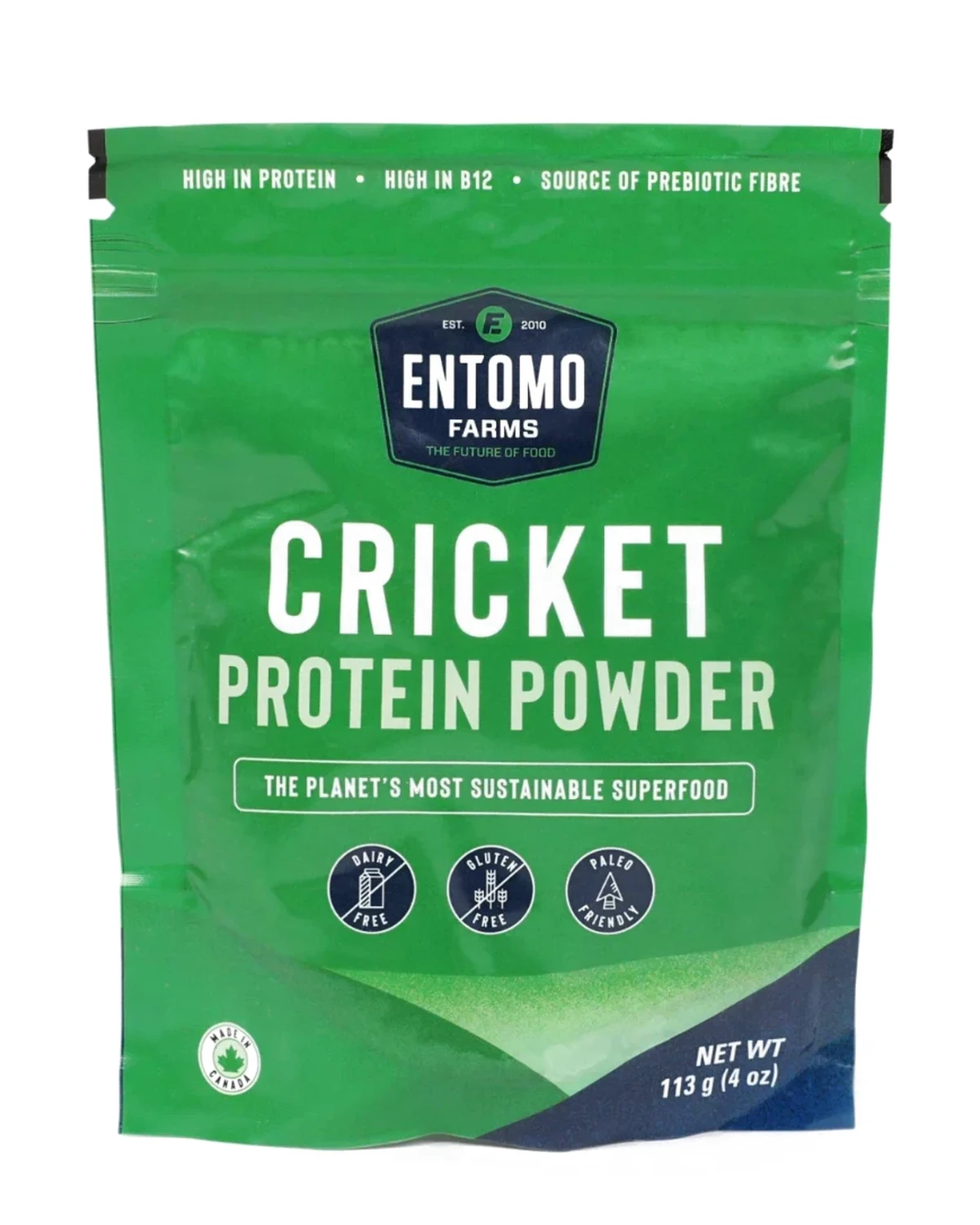
Composition
What 100 g of cricket powder contains.
From the specification, version 24-1. The full panel is on the cricket powder page.
| Per 100 g | Value |
|---|---|
| Protein | 67 g |
| Fat | 18.1 g |
| Carbohydrates | 9.7 g |
| Fibre | 6.7 g |
| Calcium | 230 mg |
| Iron | 4.3 mg |
| Potassium | 1.1 g |
| Vitamin B12 | 38 µg |
| Energy | 456 kcal |
- One ingredient: 100% cricket, Gryllodes sigillatus, no additives or preservatives.
- A level tablespoon is about 10 g, which is roughly 6.7 g of protein.
- Fibre comes from chitin, the structural material of the exoskeleton.
- Shelf-stable for 24 months sealed, cool, and dry.
Efficiency
What the FAO says about feed, emissions, land, and water.
Entomo Farms does not publish environmental figures of its own until they are measured and verified. These are the Food and Agriculture Organization of the United Nations’ figures from its 2013 report.
- Feed
- Crickets need six times less feed than cattle, four times less than sheep, and half as much as pigs and broiler chickens to produce the same amount of protein.
- Emissions
- Insects such as crickets emit fewer greenhouse gases and less ammonia than cattle or pigs.
- Land and water
- Rearing insects needs less land and water than conventional livestock.
- History of use
- The FAO reports that insects are part of the traditional diet of at least two billion people.
In formulation
How the powder behaves.
Physical properties from the specification, and the usage guidance the company has published for its recipes.
Flavour
Nutty, with cocoa and earthy notes; light to medium brown; a uniformly fine powder.
As a share of dry ingredients
Start by replacing about a tenth of the flour or dry mix, then adjust; the powder is not a one-to-one flour substitute.
Where it goes
Cereals, bars, smoothies, snacks, baked goods, soups, and dressings; the recipe archive shows the amounts used.
Moisture
Under 5 percent moisture and a water activity under 0.5, which is why it keeps for two years.
Food safety
The statements a label carries.
- Allergens
- Contains crickets. May cause reactions in people sensitive to shellfish and crustaceans. May contain soy.
- Gluten
- Not certified gluten free, but complies with gluten free requirements.
- Dairy
- No milk allergens present, on the same line, or in the same plant.
- Species status
- Health Canada lists Gryllodes sigillatus among foods with a history of safe use that did not require a novel food assessment.
- Process
- Inspected, rinsed, roasted, cooled, ground, and packed on Entomo Farms premises; routine microbiological testing on every batch.
- Food safety
- Safe Food for Canadians licence (CFIA)HACCP policies and procedures
- Documentation
- Specification sheet and certificate of analysis with shipments; routine microbiological testing on every batch of food product we manufacture.
- Premises
- One food-grade building in Norwood, Ontario, producing since 2014.
Recipes
Twenty-seven ways the kitchen has used it.
Smoothies, soups, chili, muffins, cookies, and bars from the company’s recipe archive.
Next step
Evaluating cricket protein for a product?
Ask for the specification sheet and a certificate of analysis. A person replies within five business days.